

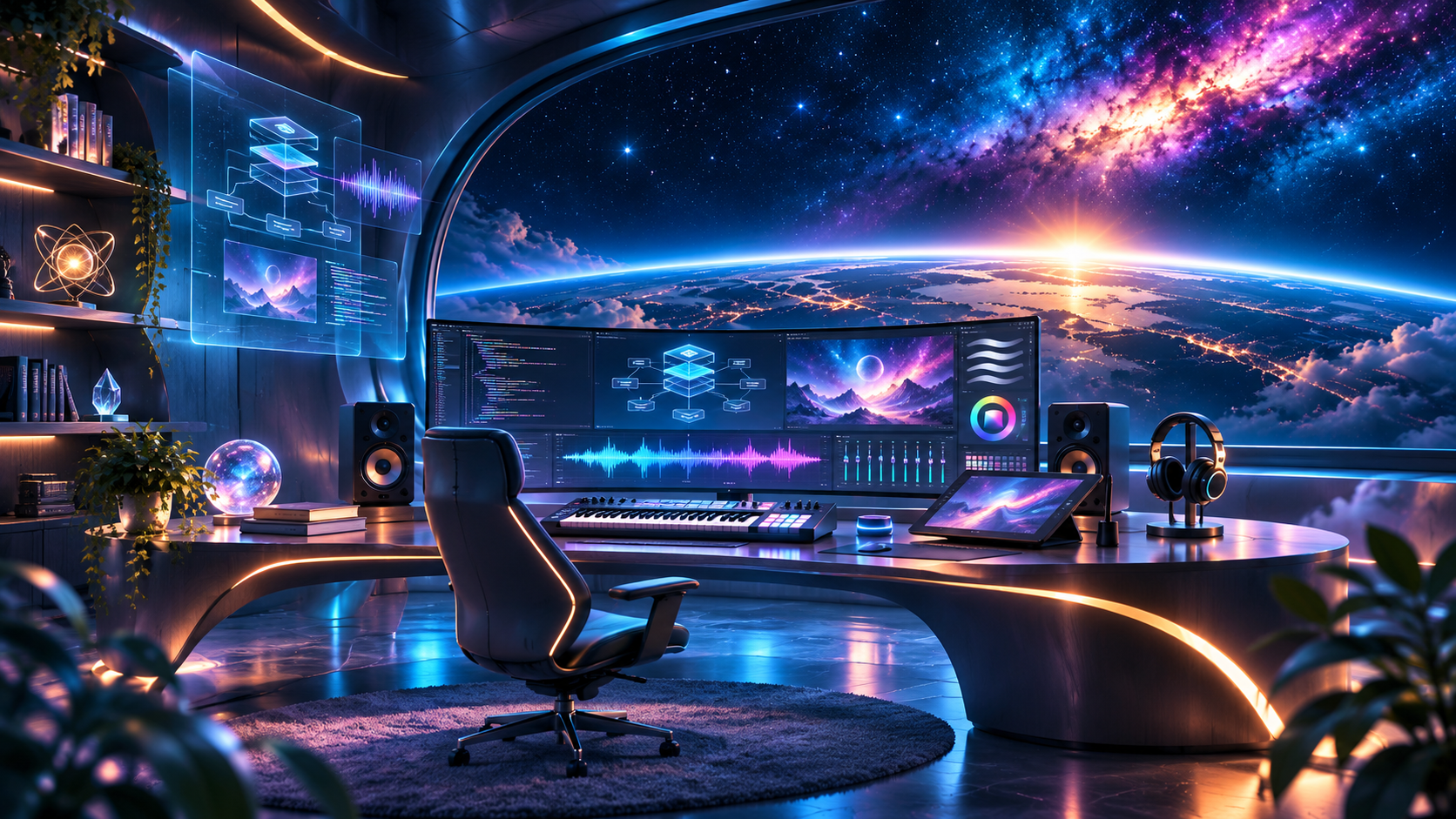
The cloud has transformed the way we create. Artificial intelligence can help us write, generate music, produce images, develop software and explore ideas that once required entire teams.
But as creative workflows become more powerful, they also become increasingly fragmented.
A song lives in one service. An illustration in another. Articles, research notes, publishing tools, source code and analytics are scattered across different platforms.
The challenge is no longer simply creating content. It is maintaining control over an increasingly complex creative ecosystem.
This is one of the reasons we are developing LORQAI Studio 3.
1. The Hidden Cost of Creative Fragmentation
LORQAI began with music. Over time, it expanded into storytelling, visual art, editorial publishing, scientific curiosity and technological exploration.
Every new creative direction introduced new tools, workflows and dependencies.
Eventually, a fundamental question emerged:
What if we could bring these creative processes together without becoming dependent on a single external platform?
We did not want another dashboard connecting dozens of services. We wanted an environment where creative work, information and operational knowledge could remain connected over time.
2. Why Local-First?
Local-first architecture is not about rejecting the cloud.
It is about deciding which responsibilities belong to the cloud and which should remain under our own control.
For a creative system, we believe that the following should remain accessible locally whenever possible:
- Original content and editorial revisions
- Creative assets and metadata
- Project structure and relationships
- Publishing history
- Operational records
- Backups and recovery mechanisms
External AI services can provide extraordinary capabilities. However, access to those capabilities should not determine whether we can access, understand or preserve our own creative work.
The cloud should extend the studio, not become its foundation.
3. Choosing a Modular Monolith
Modern software development offers countless architectural possibilities. Microservices, distributed databases and complex orchestration platforms can solve important problems at scale.
But complexity must be justified by actual requirements.
For LORQAI Studio 3, our architectural direction is a local-first modular monolith built around a Go backend, SQLite, a React and TypeScript interface, and an Astro-based static website.
This approach is intended to provide clear module boundaries without introducing unnecessary distributed infrastructure.
The objective is not to maximize the number of technologies involved.
It is to minimize the operational complexity required to produce reliable results.
A small, understandable system can be more valuable than an impressive architecture that becomes difficult to maintain.
4. Automation Without Losing Human Authority
Automation is central to our vision.
We want the system to help organize content, identify relationships, prepare publishing workflows, perform technical checks and surface operational problems.
But automation and authority are different things.
A system can identify a potential relationship between two articles. It should not silently redefine their artistic meaning.
It can prepare a publishing package. It should not automatically assume permission to publish.
It can detect an operational failure. It should not perform destructive recovery without appropriate authorization.
Our guiding principle is simple:
Automation first. Human correction where necessary. Human authority where it matters.
The purpose of automation is to reduce repetitive work, not remove creative responsibility.
5. Artificial Intelligence as a Capability, Not a Dependency
AI is an important part of the LORQAI ecosystem.
We explore generative music, visual technologies, language models, semantic discovery and emerging integration standards such as the Model Context Protocol (MCP).
However, we do not want the entire studio to depend on the availability of a particular AI model or subscription.
Models change. APIs evolve. Services introduce new limitations. Some technologies disappear altogether.
A sustainable creative environment should allow these capabilities to evolve without requiring the entire system to be rebuilt.
We are particularly interested in exploring local AI models alongside cloud-based tools, evaluating each according to its quality, reliability, resource requirements and suitability for specific tasks.
The best model is not necessarily the largest or newest one. It is the one that reliably solves the problem at hand.
6. Reliability Is a Creative Feature
Backups, diagnostics, revision history and recovery mechanisms may not sound particularly creative.
Yet their importance becomes obvious when something goes wrong.
A musician should not lose an original composition because a service changes its policies. An author should not lose an earlier revision because an editing workflow fails. A publishing system should not confuse a successful deployment request with independently verified public availability.
We want Studio 3 to make its operational state understandable.
What exists?
Where is it stored?
What changed?
Can it be verified?
Can it be recovered?
These questions are not secondary technical concerns. They are fundamental to building trust in a creative environment.
7. Keeping the Public Website Independent
Another important architectural decision is separating the local creative environment from the public website.
Our objective is for the public website to remain available independently of whether the local studio is running.
The studio prepares, organizes, validates and manages content. The public website serves the published experience.
This separation helps preserve operational independence and reduces unnecessary runtime dependencies.
It also reflects a broader principle: the tools used to create something should not become a permanent requirement for experiencing it.
8. Building in the Open, Thoughtfully
LORQAI Studio 3 is still under development.
Some architectural decisions and technical foundations are already established. Other capabilities require further implementation, testing and practical evaluation.
We intend to use this publication to share engineering observations, architectural decisions, experiments, challenges and lessons learned along the way.
Not every experiment will succeed.
Not every emerging technology will become part of the final system.
That is precisely what makes the process worth documenting.
Beyond Technology
LORQAI is not fundamentally a software project.
It is a creative universe.
The technology exists to support music, stories, imagination and the freedom to explore new ideas.
We are building a studio because we want to spend more time creating and less time managing the infrastructure surrounding creativity.
Perhaps the most interesting question in the age of artificial intelligence is not how much we can automate.
It is what we should preserve, what we should delegate, and what should always remain human.
This article reflects the current architectural direction of LORQAI Studio 3, an independent creative and technological project under active development. It describes design principles and development objectives rather than a claim of complete product readiness.
Created with AI assistance under human creative direction and editorial review.
Music Beyond Boundaries.
Stories Beyond Music.
Explore the LORQAI universe at https://lorqai.com
About the author
- LORQAI is an independent, human-led creative universe exploring the intersection of technology, artificial intelligence, music, art and storytelling. Our technical interests include software engineering, local-first architecture, intelligent publishing systems, generative AI, automation and human-AI collaboration. Here, we share insights, practical experiments, development experiences and lessons learned while building the LORQAI ecosystem. Music Beyond Boundaries. Stories Beyond Music. Official website: https://lorqai.com
Comments
Join the discussionNo comments yet. Be the first to comment.